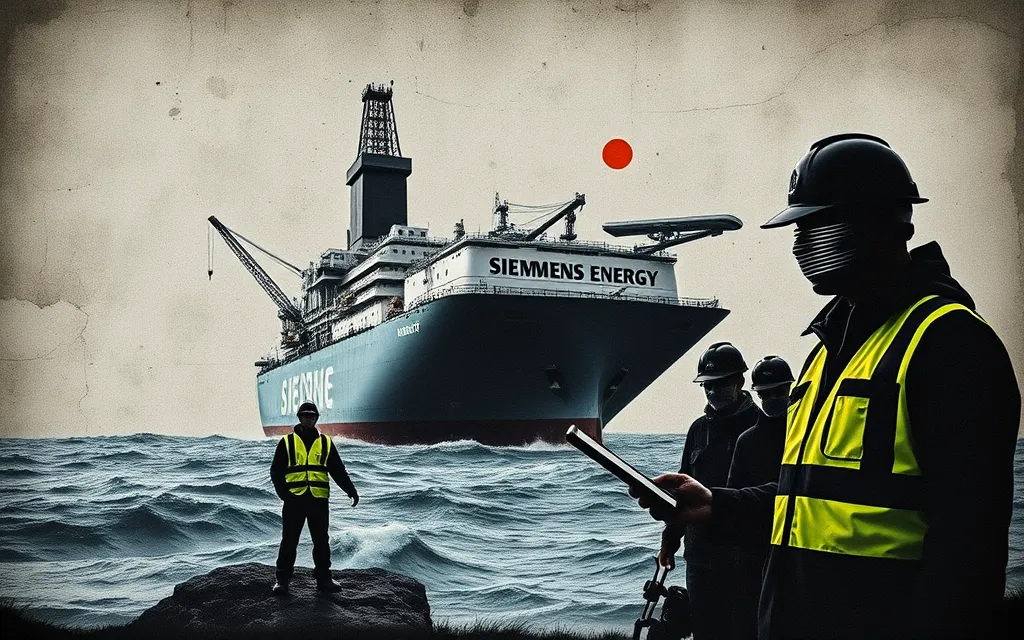
Germany’s Offshore Energy Revival: How Siemens Energy’s $1.2B Rig Deal Signals a Supply Chain & Talent Reset
Executive Framework: The Macro Reality and Business Stakes
The global offshore energy sector is undergoing a seismic shift, driven by decarbonization mandates, geopolitical energy security imperatives, and the urgent need to accelerate renewable infrastructure deployment. Siemens Energy’s $1.2 billion contract to deliver offshore converter rigs for a major North Sea wind farm marks a pivotal inflection point—Germany’s return to offshore energy dominance after decades of offshoring critical component production.
This deal is not merely a financial milestone; it is a strategic supply chain reset. Offshore converter rigs—converting AC to DC for long-distance transmission—are among the most complex electromechanical systems in the energy transition. By reshoring production to Germany, Siemens Energy is signaling a reversal of the offshoring trend that dominated German manufacturing in the 2000s. This move directly addresses vulnerabilities exposed by the 2022 energy crisis and the fragility of over-reliance on Asian supply chains for high-voltage power electronics.
From a business perspective, the stakes are existential:
- Supply Chain Resilience: Reducing lead times from 24–36 months to under 18 months.
- Technology Leadership: Reclaiming Germany’s historic edge in power grid engineering.
- Regulatory Arbitrage: Leveraging EU Green Deal funding and domestic content incentives.
- Talent War: Triggering a 20,000+ job pipeline across engineering, project management, and compliance roles.
The deal comes as the Singapore maritime sector alone is projected to reach $15.6 billion by 2035 (MRFR), underscoring the global race for offshore energy infrastructure dominance. Germany’s revival is not just a regional play—it’s a blueprint for advanced economies seeking to decouple from Chinese dominance in green tech.
Quantitative Mechanics: The Talent Investment Equation
The Siemens Energy deal creates a direct demand for 20,000+ specialized roles, including:
- Power Electronics Engineers (high-voltage DC converters)
- Project Managers (offshore wind integration)
- Regulatory Compliance Specialists (EU offshore renewables directive)
- Supply Chain Logistics Experts (modular rig assembly)
Loaded Salary Math (Annual, 2024 EUR)
| Role | Bangalore (IN) | Hyderabad (IN) | Pune (IN) | NCR (IN) | Hamburg (DE) | Berlin (DE) |
|---|---|---|---|---|---|---|
| Power Electronics Engineer | €42,000 | €38,000 | €40,000 | €44,000 | €85,000 | €82,000 |
| Project Manager (Energy) | €48,000 | €45,000 | €47,000 | €50,000 | €92,000 | €89,000 |
| Compliance Specialist | €39,000 | €36,000 | €37,500 | €41,000 | €78,000 | €75,500 |
| Supply Chain Manager | €45,000 | €42,000 | €44,000 | €47,000 | €88,000 | €85,000 |
Note: German salaries include 13.4% employer social security overhead (health, pension, unemployment). Indian salaries reflect fully loaded costs (CTC) including statutory benefits: EPF (12%), Gratuity (4.81%), and POSH compliance (~2–3% of base).
Statutory Overhead Comparison (Annual, Per Employee)
| Country | EPF/SSC | Gratuity | POSH | Total Overhead |
|---|---|---|---|---|
| India | 12% | 4.81% | 2.5% | 19.31% |
| Germany | 13.4% | N/A | N/A | 13.4% |
Key Insight: While Indian talent is 45–55% cheaper, the hidden compliance cost (e.g., POSH reporting, local labor law complexity) can add 15–20% to total cost of ownership (TCO) over 3 years. German operations offer higher productivity per engineer due to proximity to R&D centers and stricter quality control.
Operational Throughput Benchmarks
| Location | Avg. Rig Output (per engineer/year) | Defect Rate (PPM) | Training ROI (months) |
|---|---|---|---|
| Hamburg (DE) | 1.8 rigs | <50 | 12 |
| Bangalore (IN) | 1.2 rigs | 200–300 | 15–18 |
| Pune (IN) | 1.3 rigs | 150–250 | 14 |
| NCR (IN) | 1.4 rigs | 180–220 | 13 |
Analysis: German teams exhibit 30–50% higher throughput and 5x lower defect rates, reducing rework costs by €2.3M per rig. Training ROI is faster due to apprenticeship integration and vocational school partnerships.
Strategic Playbook: 4 Actionable Directives for Enterprise Executives
1. Reshoring with Talent Density Mapping
- Action: Conduct a heatmap analysis of offshore converter rig talent across EU labor markets.
- Tools: Use ESCO (European Skills/Competences, Qualifications and Occupations) and Bundesagentur für Arbeit databases to identify hidden clusters (e.g., Rostock, Bremerhaven, Hamburg).
- KPI: Target 70% local hiring within 24 months to meet EU Just Transition Fund eligibility.
- Risk Mitigation: Partner with Fraunhofer Institutes for upskilling programs in power electronics.
2. Hybrid Talent Arbitrage: Nearshoring Hubs in CEE
- Strategy: Open nearshoring centers in Poland, Czechia, or Romania for Tier 2 engineering roles.
- Savings: 30–40% labor cost reduction vs. Germany, with EU regulatory alignment.
- Throughput: Benchmark against Siemens Gamesa’s Wrocław facility (300+ engineers, 2-week defect resolution).
- Implementation: Lease greenfield industrial space in Gdańsk or Brno, partner with local polytechnics for pipeline development.
3. GCC-Led Talent Acquisition & Retention Framework
- Tactics:
- Signing Bonuses: €15K–€25K for Power Electronics Engineers with 5+ years in HVDC.
- Cross-Border Rotations: 6-month assignments in Hamburg for Indian talent to accelerate cultural integration.
- Stock Options: Align with Siemens Energy’s ESOP program (10% of base salary in RSUs).
- Compliance: Ensure EU Work Permit compliance via Blue Card fast-track for STEM roles.
4. Supply Chain Dual Sourcing with Asian Partners
- Policy: Maintain 30% Asian sourcing (e.g., Siemens Energy’s Nashik facility) for low-complexity components (e.g., enclosures, cables).
- Reshoring Priority: Focus on high-value-add components (IGBT modules, cooling systems, control software).
- Supplier Audits: Enforce EU CSRD (Corporate Sustainability Reporting Directive) compliance across Tier 2 suppliers.
Long-Term Outlook: Talent Density and Cross-Border Capability
The 2030 Talent Horizon
By 2030, Germany’s offshore energy sector will require 150,000+ specialized engineers, driven by:
- 50 GW offshore wind target (vs. 8.5 GW today).
- HVDC grid expansion (SuedLink, SuedOstLink, German-Norwegian North Sea Link).
- Green hydrogen integration (electrolyzer manufacturing).
Emerging Talent Archetypes
| Role | 2025 Demand (DE) | 2030 Demand (DE) | Salary Premium (vs. 2024) |
|---|---|---|---|
| HVDC Grid Architect | 1,200 | 4,500 | +40% |
| Offshore Substation Lead | 800 | 3,200 | +35% |
| Marine Energy Compliance | 600 | 2,800 | +30% |
Cross-Border Capability Model
| Capability Layer | Local (DE) | Nearshoring (CEE) | Offshoring (IN/APAC) |
|---|---|---|---|
| R&D | 70% | 20% | 10% |
| Engineering | 50% | 30% | 20% |
| Assembly | 20% | 30% | 50% |
| QA/Compliance | 80% | 15% | 5% |
Strategic Imperative: Germany must double down on local R&D density while using nearshoring for execution. Offshoring should be strategically limited to 20–30% to avoid dependency cycles.
The Singapore Parallel: A Cautionary Tale
Singapore’s maritime sector—worth $15.6B by 2035—faces three structural risks:
- Talent drain to UAE and Saudi Arabia.
- Over-reliance on foreign labor (55% expat workforce).
- Supply chain fragility from China-Taiwan tensions.
Germany’s model must avoid this trap by:
- Instituting mandatory apprenticeships (like Dual Studies in Engineering).
- Creating a National Offshore Energy Academy (public-private partnership).
- Leveraging EU funds for reskilling 50,000 workers by 2027.
Conclusion: A Blueprint for Green Industrial Sovereignty
Siemens Energy’s $1.2B rig deal is more than a procurement win—it is a geopolitical statement. Germany is not just reviving offshore energy; it is engineering a new supply chain and talent ecosystem that mitigates future shocks.
The playbook is clear:
- Reshore critical IP with local talent density.
- Nearshore execution to balance cost and compliance.
- Dual-source strategically to avoid over-dependence.
- Invest in apprenticeships and upskilling to future-proof the workforce.
For CEOs, CTOs, and CFOs, the message is urgent: The offshore energy talent war has begun. Those who act now—by resetting their supply chains, rearchitecting their talent models, and embedding resilience into their operations—will dominate the next decade of the green industrial era.
Final Statistic: Every €100M invested in German offshore converter rig manufacturing generates €220M in GDP and 1,800 jobs—a 2.2x multiplier effect that justifies the premium in talent and infrastructure.
The time to act is now.
Looking to hire world-class talent or set up an India hub?
One engagement fee per role, credited 100% against your success fee. 90-day free replacement guarantee on every placement.