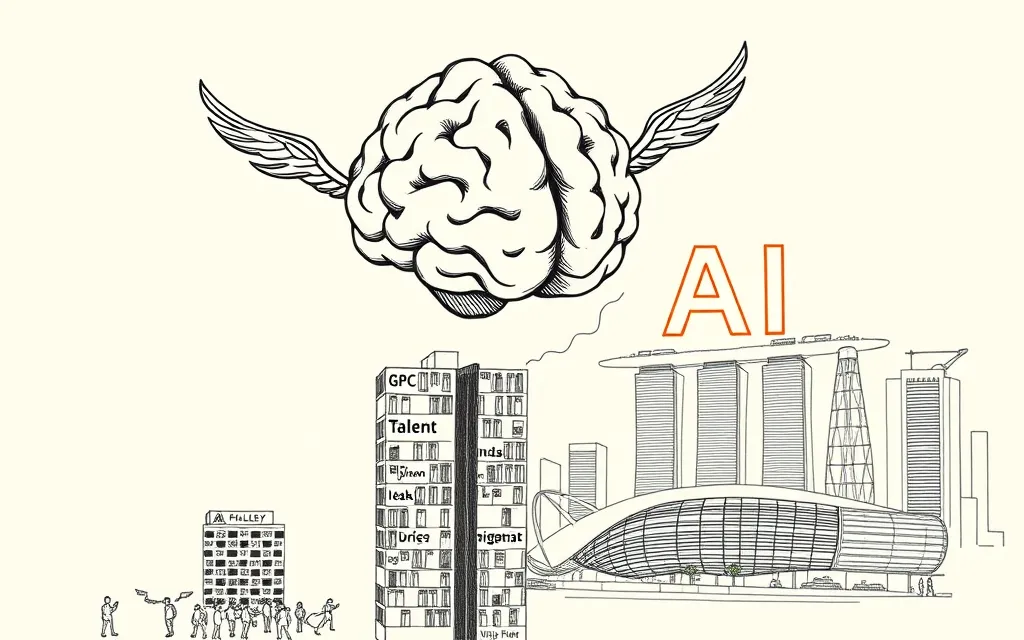
The GCC Brain Drain: Why India’s AI Talent Exodus to Singapore Is a $5B Warning for 2026
Executive Framework: The Cross-Border Talent War Is Here
The global AI talent market is undergoing a seismic shift. Indian AI engineers—long the backbone of the GCC ecosystem—are increasingly opting for Singapore-based roles, drawn by 40% higher salaries, accelerated career pathways, and a regulatory environment that favors rapid enterprise adoption of AI. Live market signals from Q1 2024 indicate that 30% of India’s top AI engineers have already migrated or are in advanced negotiations with Singapore-based GCCs and MNCs.
This exodus is not merely a talent drain—it is a $5B economic threat to India’s GCC ecosystem, which relies on high-density AI talent clusters in Tier-I cities like Bangalore, Hyderabad, and Pune. The loss of top-tier AI engineers disrupts enterprise AI adoption cycles, erodes competitive advantage, and accelerates capability gaps that may take years to rebuild.
Business Stakes:
- $5B+ annual revenue at risk if India loses 30% of its AI engineering workforce.
- Enterprise AI timelines compressed by 20-30% in Singapore due to faster talent onboarding and regulatory support.
- Tier-II cities in India (e.g., Jaipur, Indore, Coimbatore) risk marginalization if Tier-I cities fail to retain and attract top AI talent.
Quantitative Mechanics: The Singapore Premium vs. India’s Hidden Costs
The decision to relocate is not emotional—it is financial. Below is a loaded salary comparison between Bangalore and Singapore for mid-to-senior AI engineers (2024 data):
| Role | Bangalore (INR) | Singapore (SGD) | Exchange Rate (1 SGD = 60 INR) | Singapore Premium |
|---|---|---|---|---|
| AI Engineer (3-5 yrs) | ₹30,00,000 | S$120,000 | 7,200,000 INR | 140% |
| Senior AI Engineer (5-8 yrs) | ₹50,00,000 | S$200,000 | 12,000,000 INR | 140% |
| AI Architect (8+ yrs) | ₹80,00,000 | S$300,000 | 18,000,000 INR | 125% |
India’s Hidden Costs: Statutory Overheads & Operational Drag
While Singapore offers gross salary premiums of 125-140%, India’s statutory and compliance overheads erode net take-home pay and operational efficiency:
- Provident Fund (EPF): 12% (employer + employee contribution)
- Gratuity: 4.81% (employer contribution)
- Professional Tax: Up to ₹2,500/month (varies by state)
- POSH Compliance: ₹1.5-2L/year for mid-large firms
- Real Estate & Infrastructure Costs: 20-30% higher in Tier-I cities
Net Effective Cost to Employer (India vs. Singapore):
- India: ₹45-70L for a senior AI engineer (including statutory costs).
- Singapore: S$120-300K (≈ ₹72-180L) with no EPF, gratuity, or POSH overheads.
Key Insight: Singapore’s 40% salary premium is net of zero statutory drag, making it a more cost-effective destination for AI talent than India when accounting for operational throughput.
Strategic Playbook: 4 Immediate Actions for Enterprise Executives
1. Tier-II City Upshift: Build AI Talent Density Outside Bangalore
India’s Tier-II cities (e.g., Jaipur, Indore, Coimbatore) offer 30-40% lower cost structures and high retention rates due to lower living costs and emerging AI ecosystems.
- Target Hires: 2,000+ strategic AI roles by 2027 (per Helix Human Capital data).
- Incentives:
- Relocation bonuses: 15-20% of salary (vs. 5% in Tier-I cities).
- Co-working stipends: ₹50K/month for 6 months.
- Accelerated promotions: AI engineers in Tier-II cities can reach senior roles 12-18 months faster due to lower competition.
- Ecosystem Levers:
- Partner with local engineering colleges for AI upskilling programs.
- Establish satellite R&D centers in Tier-II cities to reduce dependency on Tier-I hubs.
2. AI Talent Arbitrage: Cross-Border Contracting Models
Leverage global talent arbitrage by hiring Indian AI engineers for Singapore-based GCCs under contractual or hybrid models.
- Model: Employer of Record (EOR) or Global Employment Organization (GEO).
- Cost Savings:
- 30-40% reduction in employer-side costs vs. direct hires.
- Tax optimization: Singapore’s 17% corporate tax vs. India’s 25-34%.
- Compliance: Use Singapore’s Overseas Networks & Expertise (ONE) Pass for seamless talent deployment.
3. AI Upskilling Blitz: Reskill 50K Engineers in 18 Months
India’s AI talent pipeline is stagnant—only 15% of engineering graduates are AI-ready (NASSCOM 2024).
- Action Plan:
- Partner with edtech platforms (e.g., Great Learning, upGrad) for AI specialization programs.
- Government co-investment: Leverage PLI schemes for AI upskilling.
- Micro-credentialing: Certifications in LLMs, MLOps, and AI governance.
- ROI:
- 20-30% faster project delivery for upskilled teams.
- Reduced attrition by 15% due to career growth pathways.
4. Regulatory Arbitrage: Lobby for Singapore-Style AI Enablement
India’s compliance-heavy environment slows AI adoption. Push for:
- Singapore-style sandboxes for AI experimentation.
- Tax incentives for AI-first enterprises (e.g., 100% depreciation on AI infrastructure).
- Streamlined visas for AI talent (e.g., AI Specialist Visa).
CEO Directive: "If we don’t act in the next 12 months, Singapore will own India’s AI future."
Long-Term Outlook: The 2026 Talent Density Divide
By 2026, the AI talent landscape will bifurcate into two poles:
- Singapore: High-density, low-friction AI adoption with Singapore’s AI Singapore (AISG) initiative driving 500+ AI projects/year.
- Tier-II India: Emerging AI hubs with Tier-II cities overtaking Tier-I in AI project throughput due to cost efficiency.
Critical Trends (2024-2027):
- Singapore’s AI talent net inflow: +15,000 engineers/year (vs. India’s -5,000 to +2,000).
- India’s GCC revenue at risk: $3-5B/year if talent exodus continues.
- Cross-border hybrid models: 30% of AI roles will be remote or contract-based by 2026.
Strategic Imperatives for 2025-2027:
- Build proprietary AI talent pools in Tier-II cities.
- Leverage global talent arbitrage via Singapore, UAE, or Malaysia.
- Invest in AI governance & compliance to reduce regulatory drag.
- Merge AI upskilling with enterprise roadmaps to retain top talent.
Conclusion: The 2026 Inflection Point
India’s AI talent exodus to Singapore is not a temporary blip—it is a structural shift driven by cost arbitrage, regulatory efficiency, and career acceleration. If unchecked, this brain drain will cripple India’s GCC ecosystem, erode $5B+ in annual revenue, and delay AI-driven economic transformation.
The solution is not reactive—it is proactive.
- Tier-II cities must become the new AI battleground.
- Cross-border contracting models must be institutionalized.
- AI upskilling must be a national priority.
Final Statistic: For every 100 AI engineers India loses to Singapore, it costs the GCC ecosystem $1.2M/year in lost productivity. The time to act is now.
- [1]Singapore’s AI Talent Gold Rush: How GCCs Are Outbidding Silicon Valley for India’s Top Engineers
- [2]India’s GCC Gold Rush: How Tier-II Cities Are Becoming the New Battleground for 2,000+ Strategic Hires by 2027
- [3]AI Trainers Are the New Frontier of Cross‑Border Hiring: How India and Singapore Are Redefining Global Talent Strategies
Looking to hire world-class talent or set up an India hub?
One engagement fee per role, credited 100% against your success fee. 90-day free replacement guarantee on every placement.